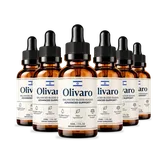
Olivaro Clinical Studies: Is It Clinically Proven?
Quick answer
No published clinical trial of the finished Olivaro formula turned up when we searched PubMed and ClinicalTrials.gov on November 29, 2026. Studies exist for some individual ingredients, such as chromium, gymnema and ginseng, but at doses and extracts that Olivaro’s label does not match, so the product should not be described as clinically proven.*
The short version, and how we checked
Search for “Olivaro clinical study” and you will land on pages full of star counts, percentages and phrases like “clinically tested”. We wanted to know whether any of it leads back to an actual study, so on November 29, 2026 we ran three checks ourselves.
- PubMed (search for olivaro) returned 11 results. None is about a supplement. They are plant chemistry and food science papers, and the name appears to be an author’s surname.
- ClinicalTrials.gov (search for olivaro) listed 0 studies.
- The official order page makes no clinical claim at all. It carries the standard FDA disclaimer and says testimonials are not guarantees. That restraint is to its credit.
Searches can miss things. A trial could sit under a different name or never have been published, so read this as “we found nothing”, not “nothing exists”. But having looked, we would not call Olivaro clinically proven, and you should be wary of any page that does.
“Clinically proven” can mean four different things
| Phrase you will see | What it usually means | Does it show the product works? |
|---|---|---|
| Clinically proven formula | A trial tested this exact product | Yes, if the trial is published and well designed |
| Contains clinically studied ingredients | Some ingredients have studies, often at higher doses | No |
| Clinically tested for safety | Ingredients were assessed for safety | Not for effectiveness |
| “91% saw results” | A customer survey or testimonials | No, there is no comparison group |
Some third-party review pages blur the second row into the first. Olivaro’s own order page does not.
What the ingredient research does support
Honestly, it is a mixed picture, and it is mostly about single ingredients at doses that Olivaro does not disclose (see the blend math).
- Chromium: NIH describes the evidence as mixed, with small effects more likely in people who are low in it (NIH ODS).
- Gymnema: a body of small, short trials, many in people who already have diabetes (PubMed).
- Panax ginseng: NCCIH notes some small studies suggesting a blood sugar effect but limited quality (NCCIH).
- Green tea: mixed results for most outcomes (NCCIH).
- African mango: a handful of small trials (PubMed).
NCCIH’s overall summary on supplements and diabetes is that there is not enough evidence to show any of them helps manage the condition (NCCIH). That applies to every product in this category, not just Olivaro.
How to read a supplement study in five minutes
- Who was studied? People with diabetes are not the same as healthy adults.
- Was there a placebo group? Without one, improvement could be anything.
- How long and how many? Eight weeks and 30 people is a hint, not a verdict.
- What was measured? Fasting glucose or A1C is meaningful. “Felt better” is not.
- Same dose and extract as the product you are buying? This is where most claims fall apart.
- Who paid for it? Not disqualifying, but worth knowing.
What would change our mind
A registered, randomized, placebo-controlled trial of the finished Olivaro formula with fasting glucose or A1C as the outcome, published where anyone can read it. Until then, our position is that Olivaro is a reasonable low-risk thing to try for some adults, not an evidence-backed treatment.*
So how should you decide?
With no product-level proof, your own results and the 60-day guarantee do the work. We wrote a plan for testing it fairly, and our main review covers the rest. If you take diabetes medicine, talk to your doctor first (Olivaro and metformin).
Olivaro FAQ
Is Olivaro clinically proven?
We found no published or registered clinical trial of the finished Olivaro formula. Some ingredients have been studied individually, at doses the label does not match.
Why do some reviews say Olivaro is clinically tested?
Usually they mean the ingredients have been studied. That is not the same as the product being tested.
Are the 4.9-star ratings evidence?
No. Ratings are not controlled studies, and several review pages repeat the same testimonials word for word.
Does lack of a trial mean Olivaro does not work?
No. It means nobody has shown whether it does. Absence of evidence is not evidence of absence, but it is a reason for realistic expectations.